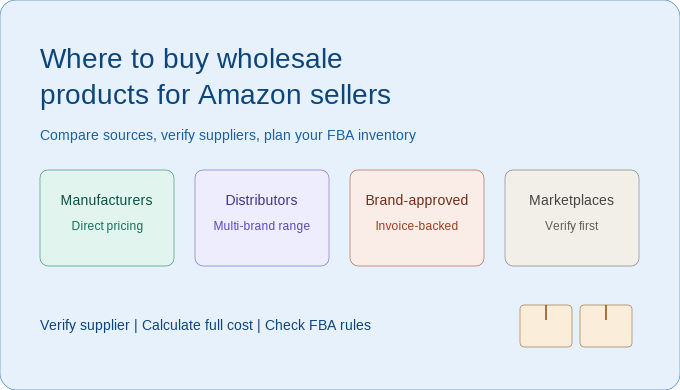
If you are wondering where to buy wholesale products for Amazon, several options are worth exploring. You can purchase directly from manufacturers, work with established wholesale distributors, explore brand-approved suppliers, or build relationships with businesses that specialize in particular product categories.
However, not every source offers the same purchasing conditions. Some require higher minimum order quantities, while others offer more flexibility in product selection, documentation, and fulfillment.
Choosing the right source can make purchasing easier and help you manage your inventory more carefully. This guide explains the main places to buy wholesale products for Amazon and what to consider before placing an order.
1. Buy Directly From Product Manufacturers
Manufacturers are one of the first places Amazon sellers can consider when looking for wholesale inventory. They produce the products themselves and may offer bulk purchasing arrangements to qualified businesses.
Buying directly can be useful when you already know which brand or product you want to sell.
For example, if you operate in beauty, personal care, household supplies, or electronics, you can contact manufacturers in those industries to ask about their wholesale purchasing programs.
Before approaching a manufacturer, prepare basic business information, including:
- Your registered business name and contact details
- Business website or online store
- Resale certificate or relevant tax documentation, if required
- The products and quantities you are interested in purchasing
- Information about your intended sales channels
Keep in mind that some manufacturers work only with large distributors or established retail accounts. Others may have minimum purchasing requirements that are difficult for smaller Amazon sellers to meet.
When this option makes sense: Direct manufacturer purchasing is worth exploring when you have a clear product target, sufficient purchasing capacity, and can meet the manufacturer’s account requirements.
2. Purchase Inventory From Wholesale Distributors
Wholesale distributors are another practical source for Amazon sellers. They purchase products through established supply arrangements and sell inventory to retailers and other eligible businesses.
Instead of contacting several manufacturers individually, sellers can explore a distributor’s available product range and review different brands or categories through one wholesale account.
This can be especially useful when you want to source products across multiple categories, such as:
- Health & Household
- Beauty & Personal Care
- Baby Care
- Electronics
- Pet Supplies
- Grocery and everyday essentials
However, choosing a distributor should involve more than comparing product prices. Check the business information, available inventory, purchasing conditions, documentation, shipping arrangements, and customer support.
Ask questions before placing a large order. Confirm whether the supplier can provide the required invoices and whether the products suit your intended marketplace.
When this option makes sense: Wholesale distributors can suit sellers who want access to branded inventory without negotiating separately with every manufacturer.
3. Explore Brand-Approved Wholesale Sources
Some Amazon sellers prefer suppliers with established relationships with specific brands.
This matters more when selling branded products because product authenticity and purchase documentation matter. Amazon may request invoices or other records to verify the source of inventory.
Before purchasing, ask the supplier:
- What is the relationship between the supplier and the brand?
- Can the supplier provide an invoice showing the purchased products?
- Does the invoice include the business and product information required for verification?
- Are there restrictions on selling the products through Amazon?
- Is the product eligible for resale through your intended sales channel?
Do not assume that purchasing a branded product automatically permits you to list it on Amazon. Some brands and product categories have additional selling requirements.
An invoice also does not guarantee Amazon approval. Amazon reviews documentation under its own policies, and sellers should check account and product eligibility before investing in inventory.
When this option makes sense: Brand-approved sources are worth considering when you want to build a catalog around established brands and need clear information about product origin and documentation.
4. Use Wholesale Marketplaces Carefully
Wholesale marketplaces allow businesses to discover products and communicate with potential suppliers through online platforms.
They can help you explore unfamiliar categories, compare product ranges, and identify purchasing opportunities. However, sellers should understand that a marketplace listing does not automatically verify the supplier or the product.
Before making a purchase, investigate the actual business selling the inventory.
Look for:
- A verifiable company name and business address
- Clear product descriptions and brand information
- Transparent wholesale pricing
- Minimum order requirements
- Written purchasing and return terms
- Product authenticity documentation where applicable
Be especially careful when a listing offers branded products at unusually low prices. Request supporting information and independently verify the supplier before sending payment.
Wholesale marketplaces can help with initial research, but base the final purchasing decision on supplier verification rather than the appearance of a product listing.
When this option makes sense: Online wholesale marketplaces can help you explore product categories and find potential sources, as long as you do proper checks before ordering.
5. Find Wholesale Suppliers in Your Product Category
Not every wholesale supplier deals with every type of product. Some specialize in household essentials, while others focus on beauty, electronics, pet products, or healthcare-related inventory.
Searching by category can help you focus your research.
For example, instead of searching only for general wholesale products, try more specific phrases such as:
- Beauty and personal care wholesale suppliers
- Household products wholesale distributors
- Wholesale pet supplies for online retailers
- Electronics wholesale suppliers in the USA
- Baby care wholesale distributors
- Amazon FBA wholesale suppliers in the USA
A category-focused search can help you find suppliers whose inventory is more relevant to your store.
It also makes supplier comparisons easier. You can evaluate similar products from different businesses rather than comparing unrelated items with different purchasing conditions.
Before ordering, review each product individually. Check selling restrictions, expiration dates (where applicable), packaging, condition, wholesale cost, and expected selling expenses.
6. How to Decide Which Wholesale Source Is Right for Your Amazon Business
Finding several suppliers is not the same as finding the right supplier. A business may offer attractive prices but have limited stock, while another may provide better documentation or more suitable order quantities.
Use the following comparison when evaluating your options:
What to compare What to check
Product authenticity Can the supplier explain and support the product’s origin?
Wholesale pricing Does the cost leave room for fees and other expenses?
Minimum order quantity Can your business afford the required purchase?
Product availability Is the inventory currently available?
Documentation Can the supplier provide appropriate invoices?
Shipping Are delivery arrangements and costs clear?
FBA preparation Can labeling, packaging, or bundling be arranged if needed?
Communication Does the supplier answer questions clearly?
Do not make your decision based on wholesale price alone. A low purchase cost may not be attractive after shipping, Amazon referral fees, fulfillment expenses, storage, returns, and other operating costs.
A supplier should fit your purchasing plan and your budget.
7. Calculate the Full Cost Before Buying Wholesale Products
One of the most common purchasing mistakes is comparing the wholesale price with the Amazon selling price and treating the difference as profit.
Several other expenses matter.
A basic product calculation should include:
- Wholesale purchase cost
- Shipping from the supplier
- Amazon referral fees
- FBA fulfillment fees, if applicable
- Product preparation and labeling
- Storage expenses
- Advertising costs, if used
- Potential returns and other operating expenses
Example:
Suppose you purchase a product for $12 and plan to sell it for $25. The apparent difference is $13, but that’s not your actual profit.
You still need to subtract Amazon fees, shipping, prep costs, and other sale-related expenses.
Use Amazon’s current Revenue Calculator to estimate applicable selling and fulfillment fees before placing an order.
It is also worth checking the product’s sales history and competition. A product with a good estimated margin may still be hard to sell if too many sellers compete for the same customers.
8. Check Amazon Selling Requirements Before Placing an Order
A product being available from a wholesale supplier does not necessarily mean you can immediately list it on Amazon.
Amazon applies different requirements depending on the product, brand, category, and seller account.
Before purchasing inventory, check:
Brand and category approval: Some products require approval before you can create or sell a listing.
Product condition: Confirm whether the inventory is new, sealed, and suitable for the condition you intend to list.
Product restrictions: Certain items may have additional requirements or may not be eligible for your intended fulfillment method.
Labeling and packaging: Review the current FBA preparation requirements for your product type.
Documentation: Keep purchase invoices and other relevant records organized.
For products with expiration dates, special handling requirements, or restricted ingredients, review Amazon’s specific policies before ordering.
Checking these details in advance can help prevent situations where inventory arrives but cannot be listed or sent to an Amazon fulfillment center.
9. Prepare Your Wholesale Inventory for Amazon FBA
After purchasing wholesale products, the next step is getting them ready for fulfillment.
Depending on the product and its requirements, preparation may involve:
- Checking product quantities and condition
- Applying FNSKU labels when required
- Bundling multiple units where permitted
- Preparing packaging according to Amazon requirements
- Creating the shipment in Seller Central
- Sending inventory to the assigned fulfillment center
Some sellers handle these tasks themselves, while others use an Amazon FBA prep service.
A preparation service can help when you buy inventory in bulk or don’t have the space and equipment to handle labeling and packaging.
The key is to check preparation requirements before shipping products. Requirements vary by product, so don’t assume every item needs the same preparation process.
10. Buy Wholesale Products From Rapid Distributor
Once you understand where to source inventory, the next step is finding a wholesale supplier that fits your business requirements.
Rapid Distributor is a USA-based wholesale distributor serving Amazon FBA sellers, Walmart WFS sellers, and online retailers. The company offers branded wholesale inventory across several product categories, along with services such as FBA preparation, labeling, bundling, and order fulfillment, depending on the order and service requirements.
Sellers can explore available inventory across categories including Beauty & Personal Care, Baby Care, Electronics, Health & Household, and Lawn & Garden.
For businesses looking to purchase wholesale products for Amazon, Rapid Distributor lets you review branded inventory and discuss purchasing requirements directly with its team.
Before ordering, buyers can ask about:
- Current product availability
- Wholesale prices and minimum order quantities
- Product details and brand documentation
- Shipping arrangements
- Available FBA preparation services
You can browse wholesale products or learn more about the company’s wholesale and FBA services.
To discuss your product requirements and wholesale account, visit Rapid Distributor and contact the team.
Final Thoughts
Knowing where to buy wholesale products for Amazon matters, but choosing the right source takes careful evaluation. Manufacturers, wholesale distributors, and other business suppliers can all offer opportunities, but their pricing, documentation, inventory, and order requirements may differ.
Take time to understand each product’s total cost, verify the supplier, and check Amazon’s requirements before committing to a bulk purchase. A well-researched buying decision can help you avoid unnecessary inventory problems and create a more organized wholesale operation.
If you are ready to explore branded wholesale inventory, Rapid Distributor can help you review available products and discuss the purchasing and preparation services that may fit your business.