Finding a product for Amazon FBA sounds simple until you actually start researching. You may come across a product with thousands of sales and think it is an easy opportunity, only to discover that dozens of sellers are already competing for the same customers.
That is why choosing the best product to sell on Amazon FBA is not really about finding the most popular item. It is about finding a product that makes sense from several angles: customer demand, competition, selling price, fees, sourcing, and long-term availability.
A product can have strong sales and still be a poor choice if the profit is too small or the supply is unreliable. Good product research means looking at the complete picture before putting your money into inventory.
Start With the Customer, Not the Product
Before looking at wholesale prices, think about why someone would buy the product in the first place.
Products that solve an everyday problem or are used regularly are worth researching because their demand isn’t based entirely on a temporary trend. Customers may need them again and again, which can create a more stable market.
Customer reviews can be particularly useful during research. They show what people like, dislike, and expect from a product.
Pay attention to questions such as:
- Is the product solving a common problem?
- Do customers seem satisfied with existing options?
- Are people buying it regularly?
- Are there complaints that competing products have not addressed?
- Does the demand appear consistent rather than seasonal?
You are not trying to predict the future perfectly. You are simply trying to understand whether customers have a genuine reason to keep buying the product.
Competition Isn’t Always a Bad Thing
Seeing competitors on an Amazon listing does not automatically mean you should walk away.
In fact, competition can signal that customers are already buying the product. The bigger question is whether the market is too crowded for the numbers to work in your favor.
Take a closer look at the competing listings. Compare their prices, reviews, ratings, product variations, and overall presentation.
A product with thousands of reviews may be difficult for a new seller to compete against. On the other hand, a product with established demand and a more manageable competitive landscape may deserve a closer look.
The goal is not to find a product with no competition.
The goal is to find reasonable competition around a product that people already want.
Don’t Confuse Sales With Profit
This is where product research becomes much more important.
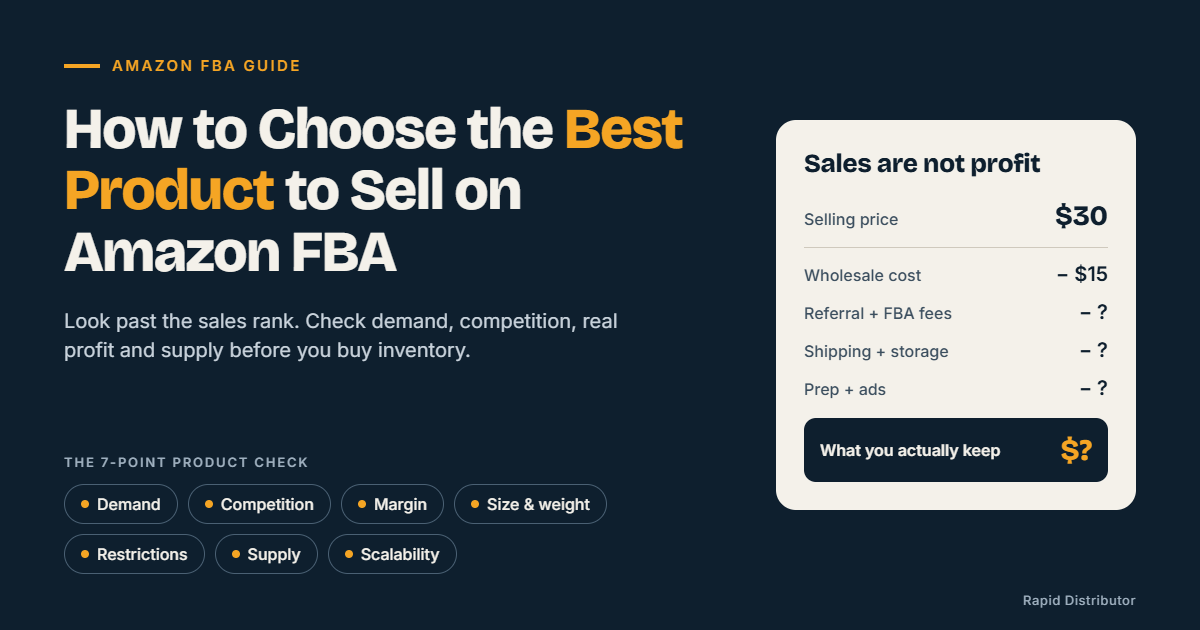
Imagine you find a product selling for $30 on Amazon and your wholesale price is $15. At first, the $15 difference may look attractive.
But then you account for Amazon fees, FBA fees, shipping, storage, preparation, and other expenses.
Suddenly, that $15 difference may be much smaller.
Before placing an order, work through the numbers and ask:
What will I actually keep after all costs?
Your calculation should consider:
- Wholesale product cost
- Amazon referral fees
- FBA fulfillment fees
- Shipping expenses
- Storage costs
- Advertising expenses
- Preparation or labeling costs
- Other operating expenses
A product doesn’t become profitable just because it has a high selling price. What matters is whether the numbers still work after you account for the full cost of getting that product into the customer’s hands.
Pay Attention to the Product Itself
Sometimes the product looks good on paper, but the physical characteristics make it difficult to manage.
Size and weight matter. Fragile products can create additional handling concerns. Products that require special preparation may also take more time and money to get ready for fulfillment.
This is particularly important when you are purchasing wholesale quantities.
A compact, easy-to-handle product may be simpler to store, prepare, and ship than a large or fragile item. That does not mean larger products cannot work. It simply means their additional costs should be included in your research.
Think beyond the Amazon listing.
Think about what happens from the moment you purchase the inventory until the customer receives it.
Look Beyond Short-Term Trends
Trending products can be tempting.
You see a product suddenly gaining attention, sales increasing, and everyone talking about it. The problem is that trends can attract sellers very quickly.
By the time you source the product, receive your inventory, prepare it, and start selling, the market may already have changed.
That doesn’t mean you should always avoid trending products. They can create opportunities when you research them properly.
But if you are building a wholesale business for the long term, products with established demand can be worth considering alongside newer opportunities.
A product customers have bought consistently for months or years can offer a more predictable starting point than something that became popular last week.
Make Sure You Can Keep Getting the Product
Finding a profitable product is only half the job.
What happens when your inventory sells out?
If your supplier cannot restock the product, your Amazon listing can suffer from stockouts, and you may have to start the sourcing process again.
This is why supplier reliability should be part of product research from the beginning.
Before committing to inventory, find out:
- How consistently is the product available?
- Is the inventory authentic?
- Can you reorder when stock gets low?
- Are wholesale prices reasonable?
- Does the supplier provide proper business documentation?
- Can the supplier handle the volume you expect to purchase?
A good product with an unreliable supply chain can become a difficult product to manage.
Don’t Forget Amazon’s Rules
A product can look profitable and still not be suitable for your account.
Certain brands, categories, and products may have additional selling requirements. Before purchasing inventory, check whether you are eligible to sell the product and whether Amazon requires additional documentation.
Wholesale invoices can also become important when Amazon asks sellers to provide proof of purchase or documentation for eligible brands.
This is one reason working with an established wholesale source can make the sourcing process easier. Rapid Distributor provides authorized wholesale invoices for eligible brands, along with wholesale inventory and other seller services.
However, sellers should always check Amazon’s requirements because Amazon ultimately makes approval decisions.
A Product Should Fit Your Business
No single product is perfect for every Amazon seller.
Your budget, experience, account status, storage situation, and sourcing options all matter.
For example, a product may have excellent demand but require more capital than you are comfortable investing. Another product may have lower sales but fit your budget and operating model much better.
When comparing products, consider the complete opportunity rather than focusing on one number.
A simple product check can look at:
Demand — Are customers already buying it?
Competition — Can you realistically compete?
Margin — Is there enough profit after expenses?
Size and weight — Can you manage the fulfillment costs?
Restrictions — Are there any Amazon requirements to consider?
Supply — Can you purchase the product consistently?
Scalability — Does the opportunity still make sense if you increase your order volume?
The more of these areas that make sense, the stronger the product opportunity becomes.
Wholesale Sourcing Can Make the Process Easier
Once you know what type of product you want, the next challenge is finding a dependable source.
Wholesale sourcing lets Amazon sellers buy established branded products in larger quantities instead of constantly searching for individual retail deals.
For sellers, this can simplify inventory planning by shifting the focus from finding random products to building relationships with reliable suppliers.
Rapid Distributor’s current inventory includes branded products across categories such as Beauty & Personal Care, Health & Household, Electronics, Baby Care, and Lawn & Garden. Its wholesale services also include FBA preparation, order fulfillment, and product sourcing support.
That support can help you spend less time managing individual preparation and fulfillment tasks and more time researching the next product opportunity.
Use a Simple Research Process
You do not need a complicated system to compare potential products.
Start with a product you are interested in and work through the following process:
Research the demand → Study the competition → Check the selling price → Calculate the complete costs → Check Amazon requirements → Confirm supplier availability → Test the opportunity → Reorder when the numbers make sense.
This approach keeps emotions out of the buying decision.
Instead of thinking, “This product looks like it sells well,” you can ask, “Do the numbers and supply conditions make this a product worth buying?”
That is a much better question.
Keep Testing and Learning
Your first successful product doesn’t have to be your only product.
As you gain experience, you will get better at recognizing good opportunities and spotting problems before placing an order. You will also learn which categories, price ranges, margins, and suppliers work best for your business.
Keep reviewing your products after they go live.
Track sales, profit, inventory levels, customer feedback, competition, and pricing changes. A product that worked six months ago may have different numbers today.
Amazon changes quickly, so product research should not stop after the first purchase.
Final Thoughts
Choosing the best product to sell on Amazon FBA is not about finding one perfect product. It’s about finding an opportunity that fits your customers, budget, selling strategy, and supplier network.
Take time to study demand and competition, calculate your real costs, check Amazon’s requirements, and ensure you have a dependable inventory source. These steps can help you make better purchasing decisions and avoid many common sourcing mistakes.
If you’re ready to explore wholesale inventory, Rapid Distributor provides authentic branded products, plus FBA prep, fulfillment, labeling, bundling, and shipping solutions for Amazon FBA and Walmart WFS sellers.
Start by exploring the available wholesale products and find inventory that fits your Amazon business strategy.